
Chinabank's Sustainability Strategy is to support its vision and mission through responsible Value Creation activities that Contribute to the environment and society, while being Resilient.
In doing so, we operate under conditions that are Viable to the company and the community. We will ensure that our contributions are Equitable to the environment and society, and that risks are Manageable.
It shall be governed by its Corporate Governance and Risk Management framework.
|
Our Approach Recognizing Chinabank's vital role in advancing sustainable development - not just by being responsible in managing the impact of our operations, but also in making responsible decisions in lending, investing, and the services we offer - we have been progressively integrating sustainability principles on three fonts: through value creation, through our contribution, and by being resilient. |
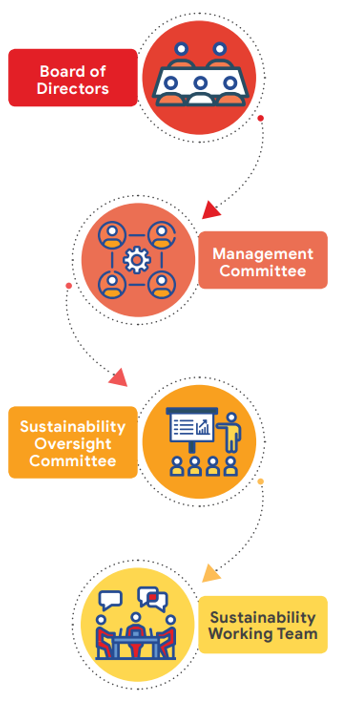
The Board of Directors has the overall oversight responsibility in ensuring that sustainability is institutionalized into Chinabank’s strategy and objectives. The Board of Directors sets the bank’s strategic priorities, which includes approaches in managing our sustainability- and climate-related risks and opportunities. Among the discussions and involvement of the Board of Directors are also in the setting of targets related to sustainability- and climate-related risks and opportunities and considered trade-offs associated with those risks and opportunities.
The Management Committee is tasked to ensure that the Bank’s operations and the performance of our personnel are in line with the set objectives on sustainability.
The Management Committee is supported by the Sustainability Oversight Committee in the implementation of its sustainability-related activities.
The Sustainability Oversight Committee aims to:
To support the Sustainability Oversight Committee’s activities, the Sustainability Working Team, led by the ESG Department, coordinates with the other units of the Bank in the implementation of actions and initiatives on capacity building, materiality assessment, and other activities under the Sustainability Transition Plan.
We engage, listen, and respond to our internal and external stakeholders to understand their concerns and expectations, improve our operations, develop long-term solutions, and foster stronger relationships with them.
How we Engaged |
Their Concerns |
Outcome of Engagements |
|
|
|
|
|
|
|
|
|
|
|
|
|
|
|
|
|
|
Our employees are the heart of our organization. By providing multiple engagement mechanisms, we make sure that our employees’ voices are heard and their insights can contribute to our operations, initiatives, and overall business direction. Chinabank also engages its external stakeholders through numerous channels to ensure that their feedback is well received and addressed. Aside from general engagement and in line with Chinabank’s prudent credit assessment, the Bank exchanges views with its external stakeholders regarding sustainability-related matters such as environment compliance certificate, community clearance, and management structure, among others.
We believe that meaningful sustainability action begins with clarity. By identifying and understanding the most urgent issues, we can respond with purpose. Our enhanced double materiality assessments serve this intent, guided by the following objectives:
|
|
Through the double materiality approach, we provide a holistic view of our environmental and social impact through the perspectives of both our internal and external stakeholders.
Assessment by Stakeholders
To ensure that the respondents have reasonable knowledge of the Bank’s business and economic activities, internal stakeholders identified as Chinabank officers were selected to participate in the materiality assessment based on the broad representation of their business/support function, area, and scope in the organization, expertise, and seniority.
On the other hand, we also engaged our external stakeholders for this assessment. External respondents were depositors selected based on their region.
Discussions were conducted to ensure understanding of the purpose, process, and validation of the results.
Evaluation of a broad range of potential
We considered various international sustainability principles such as those issued by the Global Reporting Initiative and the Sustainability Accounting Standards Board. We also incorporated topics of a more generic company rather than focused on banking to have a broader scope and to avoid excluding potential topics. As such, we arrived at a total of 26 material topics.
Focusing on What Matters Most: Chinabank’s top ten material topics
The graph below shows the prioritization of all our material topics, through the lens of our internal and external stakeholders.
The vastness of the global sustainability agenda requires a focused, localized response. Rather than attempting to address every facet, we focus on material areas where our intervention generates the highest impact. Given the Philippines’ exposure to extreme weather events, we acknowledge that climate-related risks have the potential to impact our financial health—specifically through loan exposures in high-risk regions and the operational costs of climate adaptation. Thus, sustainability and climate-related risks and opportunities are factored into our financial planning, ensuring that our growth strategy is sound and calibrated for the environmental realities of our geography.
The table below shows the identified sustainability- and climate-risks and opportunities faced by Chinabank:
Chinabank is committed to a responsible low-carbon transition that supports both the environment and economic prosperity. In 2025, we established our quantitative sustainability targets as part of our ongoing commitment to integrate ESG considerations into our business strategy. We have outlined our progress through the following initiatives and timelines:
1 Green Energy Option Program (GEOP) - a mechanism under the Renewable Energy Act of 2008 (RA 9513) that allows qualified electricity consumers to directly source 100% renewable energy from licensed suppliers.
2 Retail Competition and Open Access (RCOA) - a policy under the Philippines’ Electric Power Industry Reform Act (EPIRA) of 2001 that allows qualified electricity consumers to choose their own electricity suppliers rather than relying on local distribution utilities.
3 Retail Aggregation Program (RAP)-RCOA - a move that enables smaller, medium-sized businesses to aggregate their power demand to meet the threshold of the RCOA.
As this represents the initial year of target-setting, baseline metrics and monitoring mechanisms are currently being institutionalized. We will report progress against these targets in future disclosures.
We use a range of resources and relationships (or “capitals”) to create value for our stakeholders. These are grouped under 6 capitals and they are summarized as follows:
The 2025 Integrated Report highlights the material financial and non-financial activities of the Chinabank Group (Chinabank and our subsidiaries and affiliate) for the period January 1 to December 31, 2025, unless otherwise specified.
The report has been prepared in line with the framework, standards and/or guidelines provided by the Securities and Exchange Commission, Bangko Sentral ng Pilipinas, ASEAN Corporate Governance Scorecard, Sustainability Accounting Standards Board (SASB), and in reference with the Global Reporting Initiative (GRI) Standards. In addition, the report partially applies the International Financial Reporting Standards (IFRS) Sustainability Disclosure Standards IFRS S1 and IFRS S2 as issued by the International Sustainability Standards Board (ISSB). We plan to achieve full compliance with IFRS Sustainability Disclosure Standards when sufficient sustainability data becomes available, and after we have further refined our control systems and processes for sustainability disclosure.
The Board of Directors is ultimately responsible for Chinabank’s sustainability strategy, while Management is responsible for its implementation and for the preparation and fair presentation of this integrated report for the year ended December 31, 2025, in accordance with the sustainability reporting frameworks mentioned above.
The Board of Directors reviewed and approved the sustainability-related statements, and submitted the same to the stockholders.
The contents of this report have been reviewed by an independent auditor and an external assurance company: SyCip Gorres Velayo & Co. for the financial statements and CSRWorks International for limited external assurance based on AccountAbility’s Assurance Standard AA1000 AS v3, on the non-financial data within this Report.
Sustainability Notes and Indices
Chinabank creates value through the impact of our financial products and services to our stakeholders, the environment, and the national economy.
Read MoreGet fast answers to your queries. Check out our help center.
Visit our FAQs page